

Predicting where geothermal wells clog up
A new study published in Geothermics presents a computer model that predicts how mineral scale builds up inside geothermal wells. As hot water rises from the well's reservoir, the pressure falls and part of it boils into steam. Dissolved minerals then come out of solution and coat the inside of the well, much like limescale in a kettle, gradually choking the flow until the well has to be shut and cleaned.
Oleg Melnik and Jon Blundy developed a simulator that follows the water and steam flow, the fluid chemistry and the growing deposit together, so that each responds to changes in the others. They tested it on a calcite-clogged well at Krafla, Iceland, over the 324 days between two cleanings. The model reproduced the volume of scale measured in the upper part of the well, the depth at which boiling began, and the calcium content of the water reaching the surface.
Surprisingly, faster mineral deposition did not produce more scale where it was measured. When minerals precipitate quickly, the calcium is consumed as it forms calcite deposits deep in the well, before the water reaches the boiling zone, where the measured scale was concentrated.
Only an intermediate deposition rate matches both the scale volume and the calcium left in the water, and these two independent measurements point to the same value. When several minerals deposit at once, the model also produces scale in layers whose make-up changes with depth, a pattern often seen in real geothermal wells.

(a) Flow chart of the simulator: water-vapour flow, species transport and chemical reactions are solved each time step; (b) Krafla KJ-9 well (Iceland) after 324 days of production: simulated and measured calcite thickness for a range of deposition timescales.Credit: Melnik and Blundy 2026, Geothermics
Geothermal energy provides renewable power around the clock, but scaling remains one of the main obstacles to its wider use. The simulator developed by Melnik and Blundy is freely available for research use and offers a way to test how operating conditions affect where and when scale forms.
Read the full publication, Modelling wellbore scaling in geothermal systems using a coupled hydrodynamic–geochemical simulator, in Geothermics here: https://doi.org/10.1016/j.geothermics.2026.103870
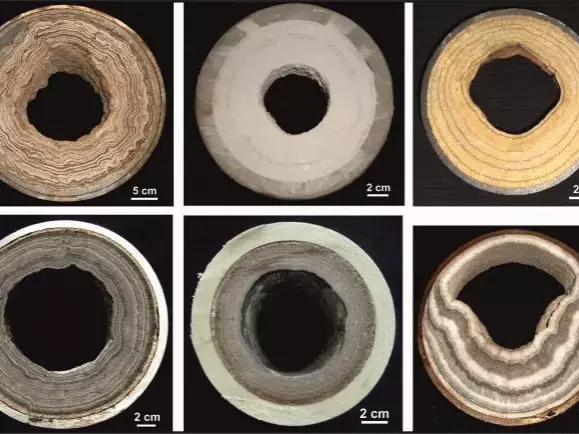
Figure 1. Multi-annual carbonate scale in pipes from Pannonian Basin geothermal facilities; banding in colour, porosity and lamination records changing conditions.Photo: Boch et al. (2016), Eur. Geotherm. Congr.